Fears, Risks, & Following Our Dreams

It had been brewing for some time. It would bubble up and haunt me, but I would talk it away – “you’re just asking for too much” I would tell myself.
“You just need to find more balance”, I would rationalize.

And yet there came a time when looking at my dissertation proposal thinking, “This is not what I want,” could not be ignored any longer. (I may have been a lump sobbing on the ground.)

The process of following one’s dreams, intuitions, and inner guidance, however, is not as easy as we would like. It requires facing fears that we have long ignored, taking risks we have felt too scared to take, and learning more about ourselves than we ever have before.

Is it even worth it?

YES.

As I write this now, I feel confident in my decision and so much more excited about my life, my place in the world, and delving into my true passions.

Was it easy to get here?

No.

First, the Fears

They’re those dehabilitating, gut wrenching, sleepless-night causing, distracting thoughts that surface all too easily and frequently when we are faced with a huge decision that marks the difference between following our dreams and continuing with the life-sucking business as usual.

Some common ones that surfaced for me were:

  • I will have wasted so much time. I had already put 4 years into my PhD program, how could I possibly turn away from that? How could I ever recover from having spent so much time on this pursuit only to leave it behind?
  •  What will I do instead? Although I had a vague idea of the direction I wanted to move in, it was not solidified (and it’s still a work in progress). All I knew for sure was that my current direction felt wrong, and that I was about to commit myself to at least 3 more years of the same.
  •  What about money? If I was to leave my position as a Graduate Research Associate, where would I get paid? How would I have rent money? Insurance?
  • What will people think of me? How would I explain the decision to leave? Would people think I’m crazy to give up this role?
  • Who will I be? I’d labeled myself as a PhD candidate for so long and became so used to the way that people responded to that. How would I define myself now? Who am I anyway?
  • What if I make the wrong choice? How would I truly know if it was the right decision to change my path? Would I regret it later?

Then, the Risks

Despite all of the fears, something deep inside kept nagging me that I was on the wrong path, that I would get stuck in a life that wasn’t what I desired, and that I would remain dissatisfied. In the face of overwhelming fear, I decided to take some risks and trust that:

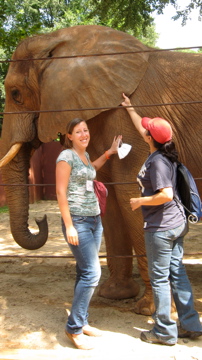
  • I hadn’t wasted time. The lessons that I learned while working and studying at the zoo were invaluable. They helped to shape my understanding of what sustainability really means (and that I couldn’t reach my ideal for a sustainable life working in a zoo), allowed me to practice and further develop my critical thinking and writing skills, and left me with a lot of fun memories and experiences that many people will never have. And I still got a Master’s degree in Biology out of it.
  • My true life direction would become available to me. As soon as I made the decision to leave the zoo, doors began opening for me. To be honest, at first I was not excited by this because I felt so guilty and worried that I made the wrong decision, but now these doors are my constant reinforcement that I am following the right path.
  • My friends and family wouldn’t let me be without food, water, and shelter. People have helped support me in ways that I could not have imagined were possible before I started thinking about taking a new direction in my life. And things have worked out so that I haven’t had to depend on anyone else for my basic needs (at least not too much – maybe someone who only lives with me ½ of the time now helps me with part of my rent – thank you!), and I’ve certainly depended on others for moral support (and it would have been ok to ask for more if I needed it)!
  • My own goals, desires, and dreams are more important than what other people think. And it also turns out that people really respect you for following your dreams. It’s a rare enough thing that it impresses others when people are actually willing to do this.
  • I am a dream-follower, authentic human who doesn’t need to be attached to labels to help give myself meaning or prove that I’m intelligent. So what if I don’t have a PhD? Maybe I’ll get one sometime in the future, or maybe I won’t. They don’t automatically equal intelligence and the life of your dreams.
  • There are no wrong choices, only moments for learning. That’s just the way it is.
And Then You Realize How Much You’ve Learned

Through all of the sleeplessness, the false alarm emergency room visits for heart attacks (this was a hard decision!), the tears, the fears, the worries, and then the risks, I have learned a lot. Not only about myself, my strength, and my capacities, but also about the life I want to create and how to do it.

Facing such a major decision made me want more than just intuition-based feelings that I was making the right decisions, so I also came up with long lists of real-world reasons that my decision would make the best sense for my desire to live a more healthy, sustainable, and freedom-based life. They fed right into and supported my intuitions in ways that provided me with strength to do the right thing.

I could make another bullet-point list of things that I’ve learned, but that’s what this blog is about, so look around and stay tuned for more insights!

What about You?

Are you a risk taker and dream maker? Are you living your authentic life?

Sadly, I don’t think many of us are. But you can! It might take some hard work, inner searching, determination, and de-conditioning from cultural expectations, but it’s worth it.

I believe the world would be a much more inviting, exciting, likable place if we were all following our passions and dreams rather than living in a belief system based on fear and what-ifs.

So name your fears. Acknowledge how scary and terrifying they are, and then defy them!

___________________________________

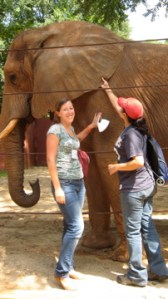
P.S. Although I enjoyed the elephant encounter shown above, I would prefer that we not keep elephants in zoos.

Why Step Lightly? It’s the right thing to do.

We must always ask the question, “Is this contributing to the repair of the world or its destruction?” (see full quote below)
The Earth flag is not an official flag, since ...

(Photo credit: Wikipedia)

I want this to be a positive space. I like having a place to share my adventures in attempting to live more sustainably and I want others to know the joy that can come from moving in this direction.

Ultimately, I like doing things that bring me closer to nature because it makes me happy — I know that it improves my psychological and physical health and I know it helps others in these ways, too.  However, it’s important to also consider more profound reasons for making these lifestyle changes. Because regardless of the benefits, it can be easy to put off these choices due to feelings of being too busy or too tired.  It’s also easy to stay distracted and to ignore the larger picture of what is happening in the world and how we are all contributing to global problems. It’s much easier to think of the troubles or desires we know in our day-to-day lives.

But we can’t ignore the large issues and our role in them any longer.  Whether you understand it from a spiritual, scientific, or some sort of hybrid standpoint, we are all connected and everything we do has an impact. We all have a responsibility to consider how our actions will impact other people and our home. If we do not address these issues, they will become a part of our day-to-day troubles in the future.

So, why step lightly? Here’s part of it, and I hope to be drafting additional “why step lightly” posts in the future.

Today I came across a 60 page report sponsored by the National Wildlife Federation that explains why the current mental health system is not prepared to address the effects of climate change (see also: Global Warming Will Mean Mental Shock and Adversity for 200 Million Americans).  Largely, the report calls on the mental health profession to address the lack of adequate training and the number of individuals that will be needed to address the psychological impacts of increased weather disruptions (think tornadoes, floods, droughts, heat waves) that will inevitably lead to destruction.   People will be displaced or die, food systems will be ruined, and a lot of us are going to have a hard time coping with the coming changes.

There are also psychological issues of guilt.  How do we feel and cope with knowing that our industrialized lifestyles are likely to be the cause of this madness and that we are forever changing the lives of people and cultures who do not contribute nearly as much to climate change? Will some of us begin to feel badly that we couldn’t slow down our consumption or use our cars less often?

There’s also fear, anxiety (where do we go so that we’re safe? how to we adapt?), and sadness over the suffering and the loss (200 species are estimated to be going extinct every day, albeit from a combination of Earth-destroying factors and not just climate change). How will people cope?  How do we inspire action instead of apathy?

Stop for a moment and think about this. How does this information make you feel? It’s very easy to push off the implications if global changes haven’t yet caused you any personal suffering.  It is easy to say that others will solve the problem, that our individual lifestyles are not contributing that much, that the issues are out of our hands… but are they really?  We’re participating in this destructive culture and we can start shifting our behavior so that we aren’t any longer.

To me, this report reminded me that I have lived in ways that have contributed to the destruction of the planet, human suffering, and species extinction and that this is not okay. I am determined to change the way that I do things. It is not up to policy makers or other people to change first. It is up to me. Hopefully, more and more of us will do the same and the policy makers will follow.

I have my fair share of anxiety about climate change and how we will manage to adapt.  Sometimes I wish that I didn’t even think about environmental issues because it can be so overwhelming, sad, and everyone seems too busy to be bothered with the news that we have to deal with these problems now.  However, I know that some of this suffering and some of the destruction can be lessened if we live more lightly now, and we will also be better prepared to adapt to the coming changes. I want to live in this way and I want to inspire others to do the same. Despite my forays into sadness, I feel very excited about the possibilities for  sustainable lifestyles to spread on a larger scale; I think that this will eventually lead to greater satisfaction and joy in our personal lives.

Even if I’m wrong and we are not responsible for our own behavior, or things aren’t as urgent as they seem, I love this passage I found that highlights the myriad reasons for changing our behavior and suggests that even if all of these reasons are wrong, it is still a way of living that brings joy. It might just be a new manifesto for me. I hope you’ll take a moment to enjoy it, too.

The real and most essential moral questions of our lives are the questions we rarely ask of the things we do every day: “Should I eat this?” “Where should I live and how?” “What should I wear?” “How should I keep warm/cool?” We think of these questions as foregone conclusions: I should keep warm X way because that’s the type of furnace I have, or I should eat this way because that’s what’s in the grocery store.  The Theory of Anyway turns this around, and points out that what we do, the way we live, must pass ethical muster first.  We must always ask the question, “Is this contributing to the repair of the world, or its destruction?”

So if you announced, tomorrow, that the peak oil issue had been resolved, we would still keep gardening, hanging our laundry to dry in the sun instead of using a dryer, cutting back and trying to find a new way to make do with less.  Because even if we found enough oil to power our society for 1000 years, there would still be climate change, and it would still be wrong of us to choose our own convenience over the security and safety of our children and other people’s children.

And if you said tomorrow that climate change had been fixed, that we could power our lives forever with renewables, we would still keep gardening and living frugally.  Because our agriculture is premised on depleted soil and depleted aquifers and we are facing a future in which many people will not have enough food and water if we keep eating this way.  To allow that to happen would be a betrayal of what we believe is right.

And if you declared that we had fixed that problem too, that we were no longer depleting our aquifers and expanding the dead zone in the Gulf of Mexico, we would still keep gardening and telling others to do the same, because our reliance on food from other nations, and our economy impoverishes and starves millions of poor people and creates massive economic inequities that do tremendous harm.

And if you told us that globalization was over, and that we were going to create a just economic system, and we had fixed all the other problems, and that we didn’t have to worry anymore, would one then stop gardening?

No. Because the nurture of a piece of land would still be the right thing to do.  Doing things with no more waste than is absolutely necessary would still be the right thing to do.  The creation of a fertile, sustainable, lasting place of beauty would still be right work in the world.  We would still be obligated to live in a way that prevented wildlife from being run to extinction and poisons contaminating the soil and the air and the oceans.  We would still be obligated to make the most of what we have and reduce our needs so they represent a fair share of what the Earth has to offer.  We would still be obligated to treat poor people as our siblings, and you do not live comfortably when your siblings suffer or have less.  We are obligated to live rightly, in part because of what living rightly gives us: integrity, honor, joy, a better relationship with our deity of choice — and peace.

–Sharon Astyk and Pat Meadows in the book Green Spirit edited by Marian Van Eyk McCain

I live this way because it fulfills me. I live this way because I think it’s necessary. I live this way because I love it.

I only hope to do it better.  I want to feel connection. I want to feel alive. I want to feel like I am contributing to life and not causing undue suffering.

I invite you to live this way, too.

Would reducing work hours help to create a better world? It just might!

I was happy to find this video on the multitude of benefits that could come from a reduced hour work week…

A change toward a reduced hour work week is likely to be necessary as we move into a future that understands our relationship with the planet and into a time of dwindling carbon resources.  Not only would this change be beneficial so that we could improve our lives by having more time for friends, family, personal development, exercise, and creativity (in addition to other reasons mentioned in the video…), but this change may also be necessary as oil becomes less readily available and as we make more sustainable lifestyle choices that lesson our contribution to issues like global warming, pollution, or human exploitation (who really makes all of your products and what is their quality of life?).

Being less dependent on oil and living with the good of all beings in mind means that we can’t outsource all of our needs to other people and ship our products/food hundreds of miles around the world — we will need to depend on our own ingenuity and local communities to provide most of what we consume.  I feel that many of us will need more time to do this (more than than is available after a 40+ hour work week, anyway).  This is especially true if we’re talking about a future where we’re not just sustainable from a resource perspective, but where we’re also sustainably healthy — both physically and psychologically. We need to spend time doing things that give us meaning, and we need to feel some sense of balance (however elusive that may be!).

It is exciting to think there could be a future ahead where people have more time to pursue things that increase their well-being and to step more lightly upon the Earth.

For some other ideas related to this, check out the Center for a New American Dream. Their mission:

We seek to cultivate a new American dream—one that emphasizes community, ecological sustainability, and a celebration of non-material values.

Sounds good to me!